Compute and the scaling trend
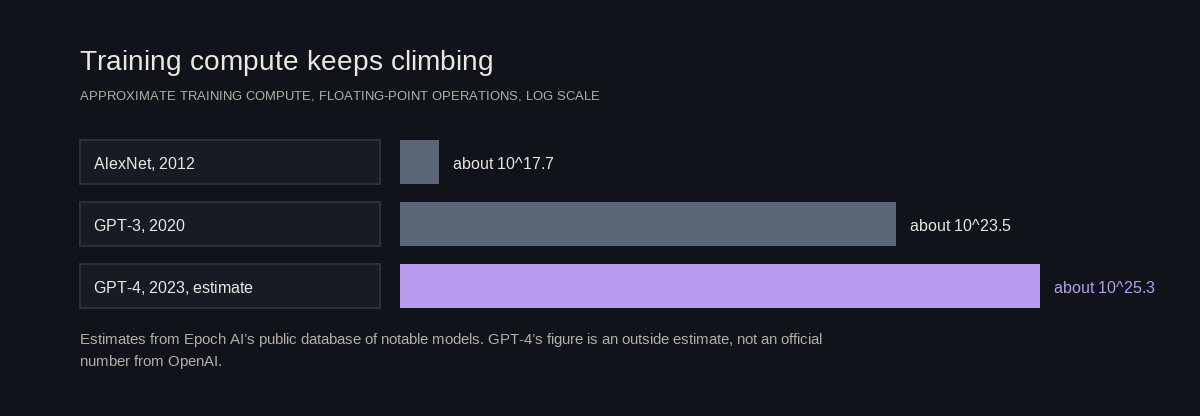
The strongest argument for fast AI progress is a graph. Here is what the graph shows, and what it does not.
From Moore’s law to training runs
In 1965 Gordon Moore, later a cofounder of Intel, noticed that the number of components on a chip was doubling about every year. He revised that to every two years in 1975. The trend held for decades and made computing steadily cheaper.
Modern AI adds a second trend on top. Companies now spend more money on each training run and link together tens of thousands of chips. The research group Epoch AI estimates that the computing power used to train the most notable models has grown about four to five times a year since 2010, far faster than Moore’s law alone.
Why more compute helps
In 2020 researchers at OpenAI published scaling laws showing that a language model’s error falls smoothly and predictably as you add parameters, data and compute. Later work from DeepMind in 2022 refined how to balance model size and data. These results gave companies a reason to build ever larger systems: the gains were not luck.
Benchmarks moved fast too. Tests that were hard for AI systems a few years ago, from graduate-level science questions to programming tasks, have been largely solved by newer models.
What could slow it
Trends are not laws. Training runs need power plants worth of electricity, huge chip supplies and high-quality data, and all three are limited. Costs per run are now in the hundreds of millions of dollars. Some researchers argue that new ideas, not just scale, will be needed for the next big steps.
There is a twist from economics. Making AI cheaper to run tends to increase total use, not reduce it, an effect our sister site Jevons Paradox explains. That pushes total compute demand up even as efficiency improves.
Reading the graph honestly
A rising curve tells you inputs are growing. It does not tell you when, or whether, a system becomes generally intelligent. For that you need forecasts, and the last guide covers how to judge them.
Common questions
Is Moore’s law dead?
The original two-year doubling has slowed, but chips keep improving through new designs, packaging and specialized processors like GPUs.
Does more compute always mean a smarter model?
It tends to reduce error on the training task in a predictable way. How that turns into useful abilities is less predictable.