Where the singularity idea came from
The idea is older than the personal computer. It started as a remark, became a warning, and then a prediction with a date.
A remark about von Neumann
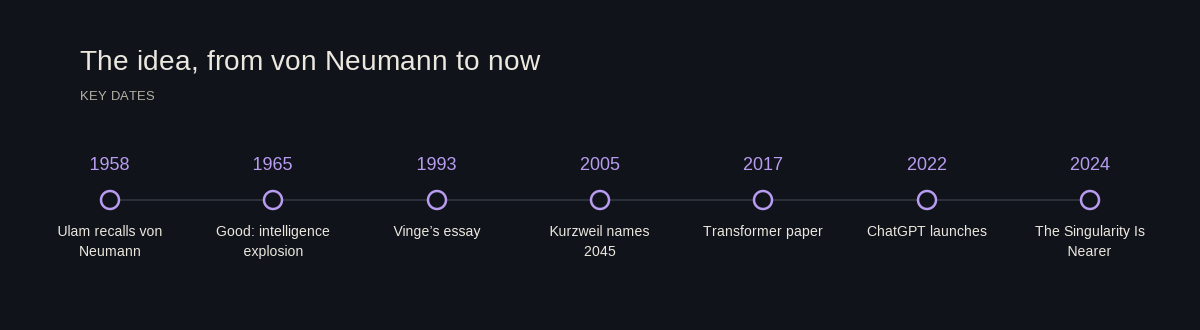
In 1958, after John von Neumann died, the mathematician Stanislaw Ulam wrote a tribute. He recalled a conversation about the ever-accelerating progress of technology, which gave the appearance of approaching some essential singularity in the history of the race, beyond which human affairs as we know them could not continue. That is the first known use of the word in this sense.
Good’s ultraintelligent machine
In 1965 the British statistician I. J. Good, who had worked with Alan Turing at Bletchley Park, made the argument more precise. He defined an ultraintelligent machine as one that could far surpass the intellectual activities of any person. Since designing machines is one of those activities, it could design better machines, and there would be an intelligence explosion.
Good wrote that the first ultraintelligent machine is the last invention that man need ever make, provided that the machine is docile enough to tell us how to keep it under control. Both halves of that sentence still frame the debate.
Vinge and Kurzweil
The science fiction writer and mathematician Vernor Vinge gave the idea its modern name and urgency in a 1993 essay, The Coming Technological Singularity, written for a NASA symposium. He wrote that within thirty years we would have the means to create superhuman intelligence.
Ray Kurzweil turned it into a forecast with numbers. His 2005 book The Singularity Is Near extrapolated trends in computing and named 2045. His 2024 sequel keeps that date, and 2029 for AI that matches humans across the board.
Why it came back
For decades the singularity was a fringe topic. The rapid gains of deep learning after 2012, and large language models after 2020, made researchers and governments take related questions seriously. The next guide looks at the compute trends that optimists point to.
Common questions
Did von Neumann predict the singularity?
We only have Ulam’s account of a conversation. It shows von Neumann thought about accelerating technology, but he left no written prediction.
Is the singularity the same as AGI?
No. AGI is a level of capability. The singularity is the idea that such capability could set off change too fast to predict.