How to read AI forecasts
Everyone has a date. Very few dates come with a definition, a method and a track record.
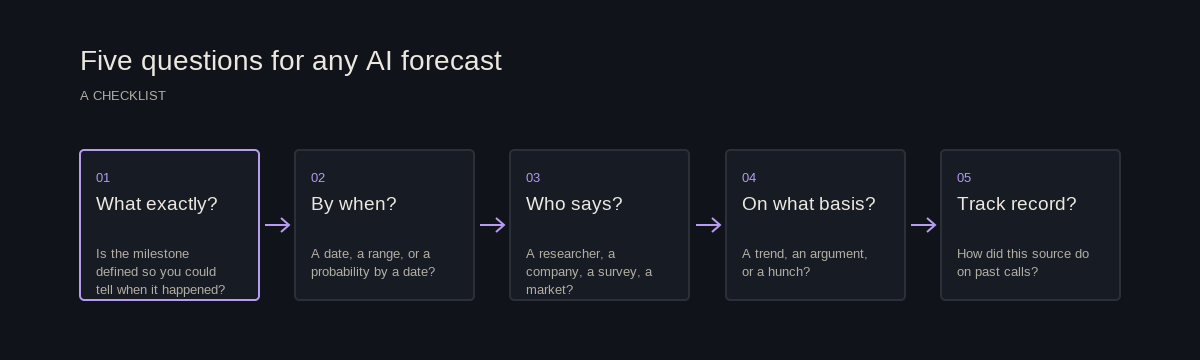
Start with the definition
A forecast that says AGI by 2030 means little unless you know what would count. Some forecasters mean a system that can do any remote job. Others mean passing a set of tests, or beating experts at most tasks. Good forecasts name a test you could check.
What researchers say
The largest survey of AI researchers, run by AI Impacts and published in 2024, asked 2,778 authors of top AI papers when machines would outperform people at every task. The combined answer gave a 50 percent chance by 2047, thirteen years earlier than the same survey found in 2022. Answers varied enormously from person to person.
Forecasting platforms such as Metaculus let anyone make and score predictions over time. Their community forecasts for general AI moved much earlier after 2022. Markets and crowds can be wrong, but they update and keep score.
Who is speaking
AI company leaders often give short timelines. They know the technology well, and they also have reasons to sound ambitious when raising money or recruiting. Skeptics often have their own stakes. Neither is a reason to dismiss a claim, but both are reasons to look for the evidence behind it.
A habit worth keeping
Write down a forecast with a date, then check it later. Doing that for a year does more for your judgment than reading another hot take. For what today’s systems can and cannot do, our sister site Sentient Cloud has plain-language guides.
Common questions
Has anyone predicted AI timelines well?
Track records are thin because the big milestones have not been reached. Short-term forecasts on benchmarks have often been too slow in recent years.
Why do expert surveys disagree so much?
Experts define the milestone differently and weigh trends and obstacles differently. The spread is itself a useful signal of uncertainty.